How to Choose a Reliable Control Valve Manufacturer? A Complete Sourcing Guide 2026
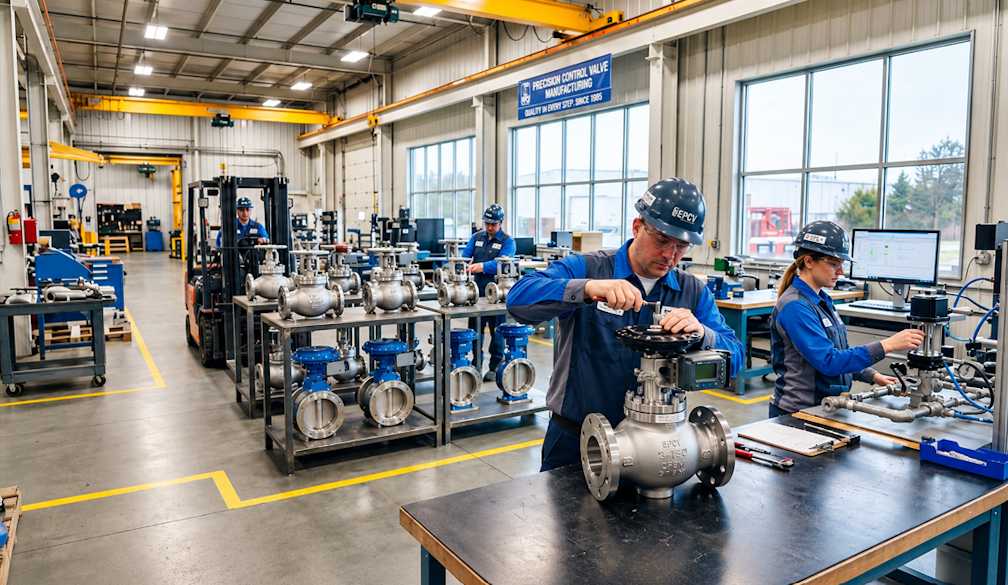
Sourcing failures in industrial piping systems rarely start with a flawed P&ID. They start with the factory behind the valve - porous castings that weep during hydrostatic testing, plug-and-cage trims that erode inside one maintenance cycle in flashing or slurry service, and inspection certificates that trace back to no test bench at all. On a plant where a single control loop governs throughput, the choice of a control valve manufacturer carries more engineering consequence than the choice of any individual valve type, because manufacturing discipline - not catalogue geometry - decides service life under real operating conditions.
Manufacturing Capability Is the First Evidence of Manufacturer Reliability
A supplier's process route tells more than its brochure, and sound valve design starts in the foundry. Cast valve bodies in WCB carbon steel remain the economical default for Class 150–600 globe and butterfly assemblies, but the foundry must qualify those castings through radiographic testing at acceptance levels appropriate to pressure-containing parts; shrinkage porosity in a cast bonnet will pass a visual check and crack out on the second thermal cycle. Forged steel valves become the right valve type at Class 900 and above, where wall integrity must withstand sustained high pressure and temperature against the ASME B16.34 ratings and casting yield alone is no longer an acceptable risk.
The machine shop matters just as much. Concentricity between seat pocket, guide bore, and stem bearing decides whether a control valve regulates flow smoothly or hunts in service. Stellite hardfacing on plugs and cage seats is standard practice for erosive and high-differential duty; blowout-proof stem design with anti-static grounding is non-negotiable in hydrocarbon pipeline service. A control valve manufacturer that keeps casting, forging, machining, and hardfacing in-house holds trim interchangeability tight across batches - a shop that outsources everything cannot, however polished its certificates look.
Verified Test Records Separate Real Manufacturers from Certificate Collectors
Pressure and seat testing is where claims become data. Shell hydrostatic tests run at approximately 1.5× the 38 °C pressure rating and seat tests at 1.1×, with hold times scaled to valve size under API 598; ISO 5208 then grades seat tightness on a defined leakage-rate scale, so a "zero leakage" quotation means nothing until the rate class is written into the datasheet. For hydrocarbon and toxic service, fugitive emission qualification to ISO 15848-1 - stem packing cycled mechanically and thermally, leakage measured in ppmv - separates valves that survive an operator's LDAR program from valves that merely passed factory air.
|
Verification item |
Governing standard |
What the record must show |
|
Shell hydrostatic test |
API 598 / ISO 5208 |
1.5× class rating at 38 °C, hold time per size, no visible leakage |
|
Seat leakage test |
ISO 5208 |
Stated leakage rate class, test medium, test pressure |
|
Fugitive emission |
ISO 15848-1 |
Tightness class, mechanical and thermal cycle counts, ppmv results |
|
Sour service trim |
NACE MR0175 / ISO 15156 |
Heat-by-heat hardness ≤22 HRC, qualified weld procedures |
|
Flow capacity |
IEC 60534-2-1 |
Rated Cv per travel, inherent flow characteristic curve |
Frankly, if a control valve manufacturer cannot tie test certificates to valve serial numbers rather than batch-level generalities, the audit ends there.
Material Selection Depth Signals Genuine Engineering Competence
The valve material recommendation a supplier makes is a window into its engineering bench. Answers built on generic "stainless steel" signal trouble ahead, because corrosion resistance is bought by grade selection, not by upgrading a nameplate. Competent houses map fluid chemistry - gas, liquid, or slurry - to specific grades and put them in writing.
|
Valve material |
Typical service |
Engineering watch-out |
|
WCB (carbon steel) |
Sweet oil and gas, saturated steam to ~425 °C |
Corrosion allowance is not a substitute for chemistry review |
|
CF8M (316 stainless steel) |
Water treatment, mild corrosive chemical |
Chloride stress corrosion risk above ~60 °C |
|
Duplex 2205 |
Seawater cooling, high-chloride brine |
Weld procedure qualification is critical |
|
Inconel 625 |
Hot sour and acidic streams |
Cost - justify by required service life |
In wet H2S service, NACE MR0175 governs trim hardness, heat treatment, and welding - not just body chemistry - and a supplier that treats it as a one-line declaration rather than a documented materials program will eventually cost a project its schedule.
Application Engineering Support Determines Control Loop Performance
A supplier earns its keep before order placement, in the sizing review. The correct process starts with process data: design flow rate, upstream and downstream pressure, differential at rated flow, density, vapor pressure, and operating temperature - converted into a required Cv per IEC 60534-2-1, with cavitation and flashing checked against the vapor pressure and pressure recovery factor of the proposed trim. Inherent flow characteristics follow the loop dynamics: equal-percentage trims where most of the system pressure drop sits outside the valve, linear trims where the valve takes most of the differential. Connection type - flanged, butt-weld, or threaded - follows the pipe class, never preference.
Body selection stays subordinate to that analysis. Globe valves with balanced cage trim remain the default for precise flow control and precise throttling; full-bore ball valves deliver tight shut-off with minimal pressure drop in on-off duty; butterfly valves suit large pipe diameters in water treatment and utility service, where a rotating disc throttles the flow path at low weight and cost; gate valves isolate but should never throttle; check valves protect rotating equipment from reverse flow. A supplier that quotes size and class without asking for process data is selling geometry, not control - and the penalty surfaces later as loop instability, cavitation noise, or lost energy efficiency.
Total Cost of Ownership, Not Unit Price, Defines Procurement Value
The cheapest valve on the order sheet is usually the most expensive one to own. Lifecycle cost in continuous-duty plants is dominated by trim replacement intervals, packing and soft-goods maintenance against the fugitive emission class, spare parts lead time, and the energy lost when flow characteristic and loop demand are mismatched. A disciplined comparison weighs unit price against the full documentation package - EN 10204 3.1 material certificates, NDE reports, seat test curves - and against the engineering hours a supplier absorbs during sizing and review. Buyers who decide on first cost alone routinely trade a 5% procurement saving for a multi-day commissioning outage.
What a Factory Audit Should Confirm Before Award?
Four checkpoints hold up in practice. First, in-house casting or forging plus CNC finishing under one quality system. Second, non-destructive examination capability - RT, UT, MT, PT - with qualified procedures, whether in-house or through a reviewed subcontractor. Third, calibrated hydrostatic and seat-test benches sized for the full pressure range quoted. Fourth, serial-number-level traceability from heat number to final test record.
Shinjo Valve, as a vertically integrated control valve manufacturer, runs sand casting and precision forging routes with in-house CNC machining, full NDE coverage, and API 598 / ISO 5208 pressure and seat testing on calibrated benches, with ISO 15848 fugitive emission qualification available for emission-critical orders. For sour gas, high-differential steam, and slurry applications, SHINJO supports project-specific test protocols, NACE MR0175 material programs, and custom trim engineering - scope that EPC contractors and plant owners can audit line by line rather than take on faith.
The Decision, Condensed
Choosing a supplier reduces to evidence: process route, test records tied to serial numbers, a materials program written in grade numbers, and a sizing review built on process data. Teams that learn how to choose the right industrial valves treat sourcing as a factory question before it becomes a catalogue question - and Shinjo Valve structures its documentation so every claim can be checked against a bench record or a mill certificate. That is the practical meaning of the right valve choice, and of a valve selection process that protects the project schedule as well as the control loop.


 Business Daily Media