Why South Australia's Construction Boom Is a Labour Story, Not Just a Building One
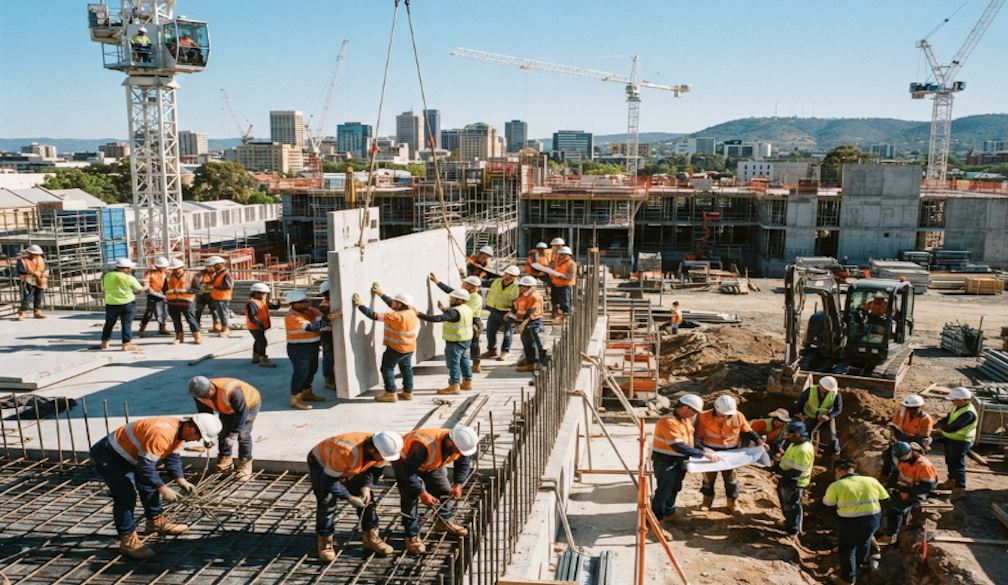
South Australia is having a moment. Over the past year, the state has posted some of the strongest employment growth in the country, and relaxed building regulations have only added fuel to an already busy construction sector. But behind the headline numbers sits a more practical question for local businesses: where is all this work actually coming from, and who's going to build it?
The Scale Behind the Numbers
The single biggest driver is impossible to miss. The AUKUS submarine program at Osborne is now underway in earnest, with the federal government committing an initial $3.9 billion in February 2026 and a further $4.6 billion in July, part of a total investment projected at around $30 billion. At its peak, the program is expected to create close to 10,000 jobs across the state, roughly 4,000 to design and build the shipyard itself, and another 5,500 to support ongoing submarine production, spanning engineering, trades, project management and logistics.
This isn't a single project ticking along quietly in the background. Enabling infrastructure work is already visible on the ground: a new access road linking Pelican Point Road to the shipyard was completed by around 170 workers and opened to traffic in February 2026, and more than 500 South Australians are currently building the site's Skills and Training Academy campus and production facilities, due to open to its first students in 2028.
Multi-Generational, Not Just Major
What sets this apart from a typical construction cycle is the timeframe. Osborne alone is expected to deliver decades of work, not years, as the state moves from building the shipyard itself through to the long production run of the submarines it's designed to build. Layer that on top of major road upgrades and the broader state infrastructure pipeline already underway, and the picture becomes clear: several genuinely large builds are running at the same time, all drawing from the same pool of skilled trades and labour.
That's the phrase industry figures keep coming back to when describing the current environment: multi-generational. It's not one boom that will taper off in a couple of years. It's several overlapping ones, each with its own long runway.
The Workforce Squeeze This Creates
When multiple large-scale projects compete for the same trades at once, the effect on the local labour market is immediate. Employers aren't just trying to fill a handful of roles; they're trying to do it while a shipyard, a road authority and a housing developer down the street are all chasing the same welders, riggers, electricians and general labourers.
Permanent hiring simply can't move fast enough to absorb that kind of demand curve. Recruitment timelines, training, and onboarding all take months a project schedule may not have. This is precisely where flexible, compliant labour hire earns its place, not as a stopgap, but as the mechanism that lets businesses scale a workforce up or down in line with what a project actually needs, without the risk of overcommitting to permanent headcount that outlasts the work.
What This Means for Local Businesses Right Now
For any business operating in or around Adelaide's construction and industrial sectors, the practical takeaway is timing. Waiting until a project deadline is looming to start sourcing workers means competing in an already tight market, often against far larger organisations with deeper recruitment resources. Planning workforce needs early, and partnering with a labour hire company that already understands the local demand curve, gives businesses a genuine head start.
It's also worth noting that this surge in activity is happening alongside tighter compliance expectations across the sector, from licensing requirements to screening standards. A provider that's already built for that environment, rather than scrambling to catch up with it, is the one worth having on side.
The Bottom Line
South Australia's construction boom isn't a short-term spike. It's a structural shift, driven by defence investment on a scale the state hasn't seen before, running alongside its usual infrastructure and housing pipeline. For businesses trying to keep pace, the real challenge was never finding the work. It's finding, and keeping, the people to do it. That's exactly where a locally embedded labour hire company in Adelaide makes the difference.


 Blackhawk Network VP Head of ANZ Kieran Nolan