10 Thermoplastic Playground Games That Double as Learning Tools
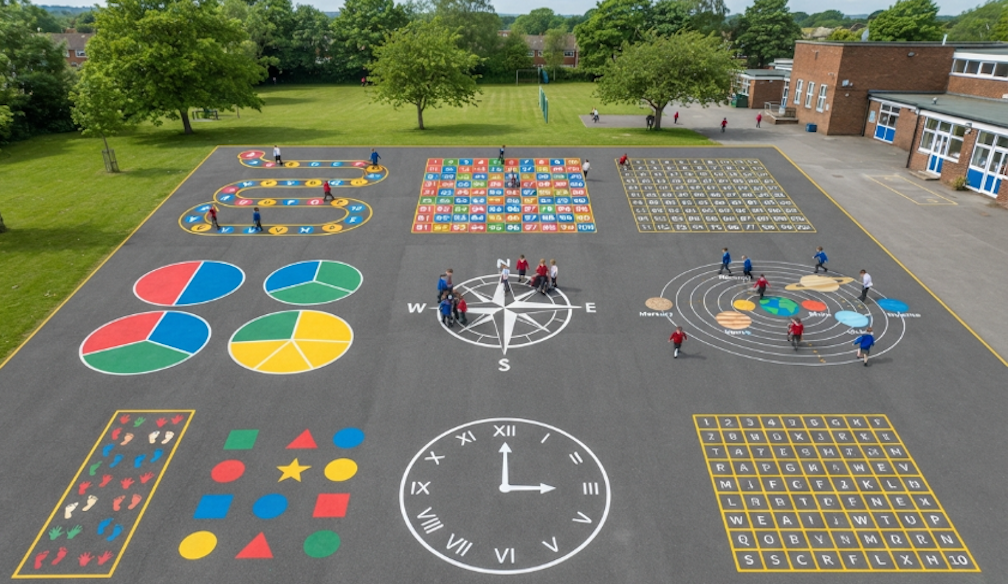
Recess used to mean one thing: running around until the bell rang. These days, a well-designed playground can do double duty, giving kids a break from the classroom while quietly reinforcing what they learned inside it. The trick lies in the surface itself. Durable, brightly coloured thermoplastic designs turn plain concrete or asphalt into number grids, maps, mazes and word games that children interact with every single day, often without realising they're practising a skill at all.
Below are ten games that schools and councils are installing right now, along with the specific learning outcome each one supports.
1. Giant Hopscotch
The classic reinvented. Numbered squares laid out in a hopping sequence build early number recognition and counting order, while the physical hopping motion supports balance and coordination. For younger year levels, this is often the first marking installed because it's instantly familiar to both students and staff.
2. Snakes and Ladders
A full-scale, walk-on version of the board game. Students move along a numbered track, climbing "ladders" and sliding down "snakes" based on a dice roll. Beyond counting, it introduces basic probability, sequencing and the patience of taking turns, something surprisingly hard to teach indoors.
3. Alphabet Trail
A winding path of letters, either in order or scattered for a treasure-hunt style activity. Teachers use it for phonics drills, spelling relays and simple letter-matching games, making it a favourite in early primary years.
4. World Map and Compass
A large-scale map with continents, oceans and a compass rose gives geography lessons a physical dimension. Children can stand on countries, trace travel routes with their feet, or play direction-following games that reinforce north, south, east and west in a way a textbook never quite manages.
5. Times Tables Track
Multiplication facts arranged along a running lane or hopscotch-style grid turn rote memorisation into a race. Kids call out answers as they move, pairing physical activity with fluency practice, useful for classes working through their times tables in upper primary.
6. Phoneme and Word-Building Squares
Individual letter sounds or word fragments are painted in a grid, and students jump between them to build words aloud. It's a favourite with literacy specialists because it gets reluctant readers moving and engaged rather than sitting still with a worksheet.
7. Maze
A simple maze pattern looks like pure fun, but tracing a path from entry to exit develops spatial reasoning and problem-solving. Older students often turn it into a timed challenge, adding a bit of friendly competition to the mix.
8. Target and Shape-Sort Circles
Concentric circles or scattered shapes in different colours support early maths concepts: colour matching, shape identification, and simple sorting games. Paired with a beanbag toss, it also builds hand-eye coordination.
9. Fitness and Distance Trail
A marked running track with distance intervals introduces measurement in a hands-on way, how far is 50 metres, really? Combined with simple exercise stations, it links physical education outcomes with basic maths and an early understanding of pacing and endurance.
10. Trading Post Number Line
A number line marked with positive and negative values, used for addition, subtraction and even introductory money concepts. Teachers set up simple "buy and sell" games where students physically move along the line to work out change or totals.
Why Thermoplastic Specifically
Paint fades within a season or two. Thermoplastic doesn't. It's heat-applied directly to the surface, bonding tightly enough to withstand years of foot traffic, weather and UV exposure without cracking or peeling. The material also carries embedded reflective beads, so markings stay visible even in low light, and most designs include a textured, slip-resistant finish that holds up in wet conditions. For a school budgeting once and expecting it to last, that combination of durability and safety makes the investment easy to justify.
Getting It Right at Your School
The best results come from treating playground line marking as part of a broader plan rather than a one-off purchase. A few things worth sorting out before the truck arrives:
- Zone by energy level. Keep high-movement games like running tracks and mazes away from quieter, seated activities like number grids, so different play styles don't collide.
- Involve teachers early. The staff who'll actually use the markings in lessons often have strong opinions on which games would be most useful, and they're worth asking before the layout is finalised.
- Match designs to year levels. A alphabet trail suits early primary; a times tables track gets more use from upper year groups. Mixing both across different zones keeps the whole playground useful.
- Think long term. Because a properly installed thermoplastic surface can last close to a decade, it pays to plan for a few years of curriculum ahead rather than just this year's needs.
Councils and community centres tend to follow a similar approach, and increasingly, school line marking projects are being scoped alongside curriculum planning rather than as an afterthought to facilities maintenance. That integrated approach, treating the playground as an extension of the classroom rather than a separate space, tends to get far more educational mileage out of the same budget.
The Bottom Line
A playground doesn't have to choose between fun and function. With the right mix of games, mapped to the skills your students are actually working on, thermoplastic markings turn an ordinary break into ten or more small learning moments a day, no extra lesson planning required.


 Blackhawk Network VP Head of ANZ Kieran Nolan