Where to spend and where to save on a business fit-out
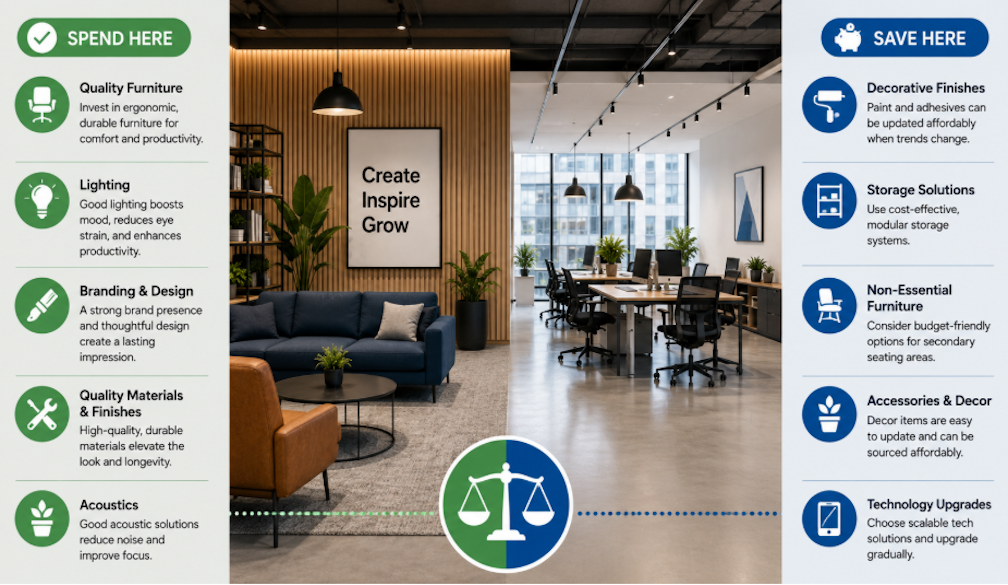
A business fit-out is easy to get wrong in one of two directions: overspending on a full refit the business does not need, or buying everything cheap and paying again when it falls apart within a couple of years. The sensible path runs between the two. Spend where it earns its keep, save where it does not, and buy for durability. Here is where the money should and should not go.
Spend where people and clients meet the space
Put the budget where it is seen and used. The seating in a reception or meeting room, and the chairs staff sit in all day, are the pieces that shape how the business is experienced and how well people work. These earn the investment.
A comfortable, good-looking chair in a client meeting, or under a member of staff for eight hours, pays back in impression and in output. This is not the place to cut, because the saving is small and the cost of getting it wrong is paid every working day.
A simple way to decide is to follow the traffic. Walk the space as a client would, then as a member of staff would, and mark every spot where someone sits, waits or is seen. Those are the pieces that carry the business. Everything on that short list deserves proper thought and a fair share of the budget; most of what is not on it does not.
Save on what nobody sees or touches
The opposite is just as true. Storage in a back office, shelving in a stockroom, the desk in a room no client ever enters: these only need to be functional. Spending designer money on furniture nobody sees is money wasted.
Buy plainly and cheaply here and redirect the saving to the rooms that matter. A fit-out that spreads its budget evenly across everything tends to end up looking mediocre everywhere, which is the worst outcome for the money and the easiest one to avoid.
Buy for durability, not just the sticker price
Commercial use is hard on furniture. A chair in an office or a waiting room takes far more use than one at home, and pieces bought on price alone tend to fail under it. When they are replaced every couple of years, the true cost is several times the original ticket, plus the disruption of doing it all again.
A well-made piece that lasts is usually cheaper over the life of the fit-out, even when it costs more on day one. Total cost of ownership, not the sticker price, is the number that matters, and it is the one cheap furniture quietly loses on.
The same logic applies to repair and warranty. A quality piece can often be re-upholstered, re-oiled or have a part replaced, extending its life for a fraction of the cost of buying new. Disposable furniture offers no such option: when it fails, it goes to landfill and the whole cost is incurred again. Ask what happens to a piece in year five before you buy it in year one.
Fewer, better pieces read as more professional
A cluttered space filled with cheap furniture reads as exactly that, however much was spent in total. A calmer space with fewer, better pieces reads as considered and confident.
Consistency helps here. A few pieces that clearly belong together do more for how a business is perceived than a random mix bought piecemeal over years. Restraint is not only cheaper to buy, it usually looks better, which is a rare case of the budget and the aesthetics pointing the same way.
It is also easier to maintain and extend. When a space is built from a small, coherent set of pieces, adding to it later or replacing one is straightforward. A patchwork of one-off bargains is impossible to match, so it tends to look worse over time rather than better.
Where reproductions fit
Design classics are a useful tool in a business fit-out, because they are comfortable, durable and quietly signal that the business pays attention to detail. Licensed originals, though, rarely suit a commercial budget across a whole space.
Faithful reproductions are the practical answer. Available from sites such as mobelaris.com, they follow the proportions and materials of the originals and are sold honestly as reproductions, which lets a business put a recognisable, well-made piece where it counts without a licensed price. Spend on the rooms people use and see, save on the ones they do not, buy for durability, and keep it consistent. Do that and a business fit-out looks considered and controls its cost at the same time, which is the whole point of doing it well rather than just doing it cheaply.


 Blackhawk Network VP Head of ANZ Kieran Nolan