How Tangible Brand Touchpoints Strengthen Employee Experience and Retention
The Australian employment landscape is undergoing a significant shift, forcing business leaders to rethink how they engage and keep their teams. Data from the Australian Bureau of Statistics in early 2024 revealed a job mobility rate of 9.5 percent, meaning nearly one in ten employed Australians changed jobs over a 12-month period. Furthermore, the 2025 Workplace Engagement Index found that half of all employees had considered leaving their roles recently. With the cost of replacing a skilled employee in a small-to-medium enterprise currently averaging between $15,000 and $25,000, proactive retention strategies are a financial necessity. Interestingly, the same index highlighted that receiving reward and recognition is the number one driver of employee productivity, cited by 43 percent of respondents. This points to a clear solution for HR leaders looking to stabilise their workforce.
Bridging the Gap in Distributed Teams
A 2025 report from the Australian HR Institute confirmed that over 80 percent of employers expect hybrid work arrangements to remain stable or increase. However, this flexibility comes with unique cultural challenges. The AHRI report identified team cohesion as a critical hurdle, with 57 percent of employers noting that a feeling of disconnection between colleagues is the primary disadvantage of a distributed workforce. When team members only interact through screens, building a unified corporate identity becomes inherently more difficult. To bridge this gap, many forward-thinking organisations are actively utilising custom merchandise as a tangible way to connect their dispersed teams.
This disconnection has led companies to invest heavily in digital HR solutions. While platforms streamline daily operations and reduce administrative friction for remote workers, technology exists primarily to clear the way for human connection, not to replace it entirely. Digital tools alone cannot fully combat the isolation felt by the 33 percent of Australian workers who reported feeling disconnected in recent industry indices. To build a robust workplace culture, companies must pair their digital infrastructure with physical, real-world touchpoints that reinforce a shared company identity and remind employees they are part of a larger community.
Why Onboarding Sets the Tone for Retention
The earliest days of an employee's tenure are often the most fragile, making the initial welcome process incredibly important. A structured introduction to the company is vital, yet it is an area where many businesses unfortunately fall short. Research from Gallup highlights exactly why the onboarding experience is key for retention, noting that only 12 percent of employees strongly agree their organisation does a great job of onboarding new hires. When this process fails, the consequences are severe. Data indicates that employee turnover can reach up to 50 percent within the first 18 months of employment. A poor induction leaves new staff feeling undervalued before they even settle into their roles.
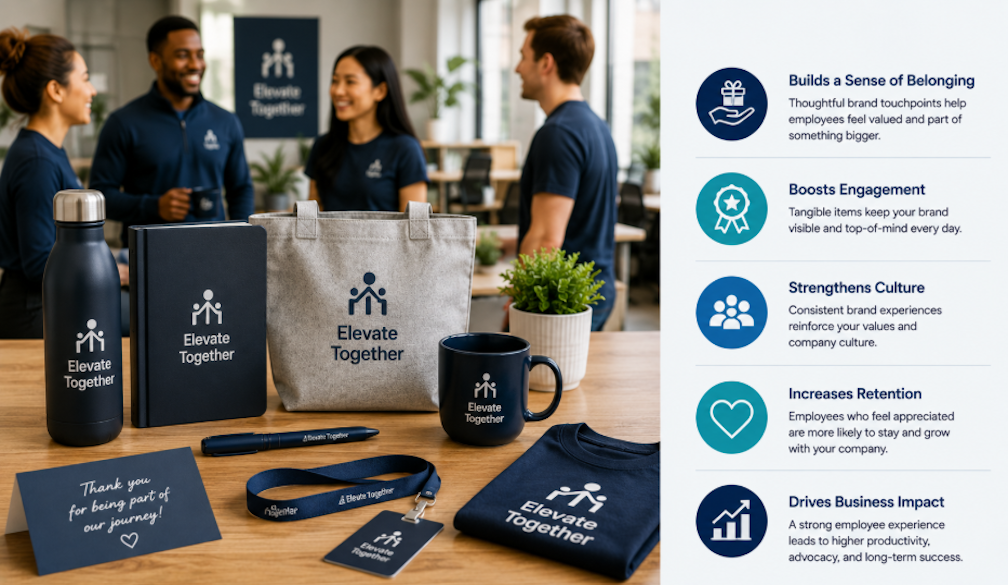
To combat this early attrition, HR leaders are rethinking the traditional welcome process. Beyond the standard paperwork and software setups, tangible welcome kits are emerging as a highly effective engagement tool. Supplying new hires with high-quality, thoughtfully designed branded items transforms a standard first day into a memorable event. A comprehensive survey of 5,000 full-time employees demonstrated that workers who receive promotional products stay at their companies significantly longer than those who do not. Furthermore, 73 percent of workers feel that receiving these physical items directly contributes to a deeper sense of belonging and organisational pride.
Crafting a Meaningful Corporate Gifting Strategy
Recognising the power of physical connection points, global industry data from 2025 shows that 68 percent of companies have actively increased their corporate gifting budgets specifically to support employee morale and reduce turnover. However, not all physical touchpoints yield the same positive results. According to Snappy's Annual Holiday Gifting survey, poorly chosen items can actually harm morale, with 63 percent of respondents stating they would rather receive no gift at all than a generic, thoughtless one. Treating corporate gifts as mere promotional giveaways misses the mark entirely.
To ensure corporate gifting investments genuinely strengthen the employee experience, HR teams should follow several core principles to guide their procurement strategies:
- Apply the Weekend Test: High-quality, stylish items that employees genuinely want to use or wear outside of working hours transform staff into authentic brand ambassadors.
- Prioritise Personalisation: Tailoring gifts to specific milestones, such as work anniversaries or the completion of a major project, shows a much deeper level of appreciation than a one-size-fits-all approach.
- Focus on Utility and Quality: Investing in premium, durable items rather than cheap office novelties ensures the gesture is perceived as a genuine reward rather than a throwaway promotional tactic.
- Integrate with Broader Recognition Programmes: Tangible gifts are most effective when they accompany clear communication and genuine verbal acknowledgment of an employee's hard work.
Measuring the Impact on Workplace Culture
Building a resilient workplace culture in a hybrid world requires a multi-faceted approach. We are already witnessing the steady rise of employee experience tech in a changing small business landscape, as companies invest in platforms to streamline remote operations. However, these digital tools must be complemented by physical engagement strategies to be truly effective. A 2026 scientific study found that employees who received company branded items scored 19 percent higher on engagement and 26 percent higher on ambassadorship compared to standard benchmarks. These figures highlight the measurable return on investment that thoughtful physical touchpoints can provide.
By carefully blending digital efficiency with tangible, physical touchpoints, Australian businesses can foster deeper connections, improve team morale, and ultimately retain their best talent for the long haul. When employees feel seen, valued, and tangibly connected to their workplace, they are far more likely to commit their long-term future to the organisation.


 Blackhawk Network VP Head of ANZ Kieran Nolan