

Personal scandals sink CEOs faster than financial fraud, research shows
- Written by: Michael Nalick, Assistant Professor of Management, University of Denver
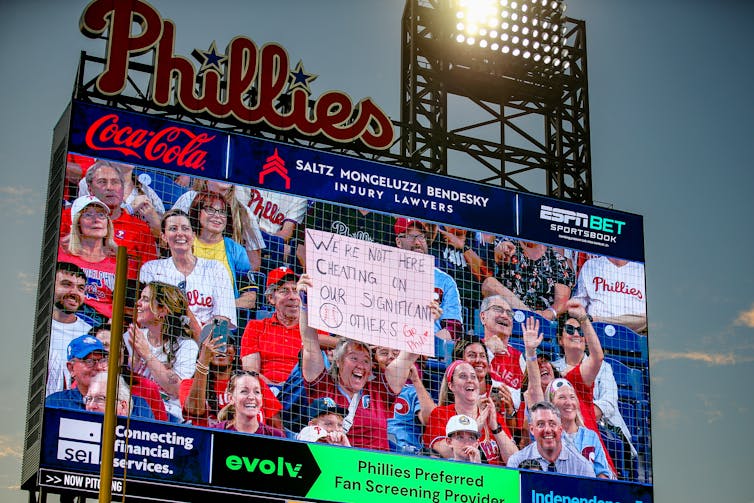
A CEO’s canoodling with his company’s human resources chief – caught on the “kiss cam” at a Coldplay concert – made[1] global[2] headlines[3] this[4] summer[5]. Beyond the memes and tabloid fodder, personal lives were shattered[6] and a company was left in turmoil after its leader’s sudden exit[7].
The case, involving the AI firm Astronomer, may be the most visible of recent CEO personal scandals – think sex affairs, drug abuse or embarrassing behavior – but it’s not an isolated incident. Just weeks following the Coldplay “kiss cam,” the CEO of Nestlé was shown the door for similar behavior involving a relationship with a subordinate[8]. Personal scandals have been the top cause of CEO terminations[9] in recent years.
How do these scandals stack up to other corporate indiscretions, such as financial fraud? As a management professor[10], I knew that there’s lots of research on CEOs’ financial crimes, but surprisingly little on personal misdeeds.
So my colleagues and I examined nearly 400 CEO scandals[11] involving either financial or personal misconduct. In this research, published in August 2025 in the journal Strategic Organization[12], we found that not all CEO scandals are treated equally: The type makes all the difference.

Personal scandals are harder to survive
For most people, personal indiscretions – such as having an extramarital affair or abusing drugs – are a private matter. But for CEOs, even scandals unrelated to business create doubt about their judgment, integrity and leadership. The result is usually career-ending for the CEO[14], research shows, and can create lasting harm for the company.
We found that CEOs overwhelmingly exit in the wake of personal scandals – five times as often as CEOs who commit financial misconduct do, in fact. And strong business performance doesn’t tend to offer protection.
For example, Hewlett-Packard’s Mark Hurd, who’s widely credited with turning around HP in the mid-2000s, was ousted following a very visible personal misconduct scandal[15] 15 years ago. The fallout was swift: The company’s stock fell nearly 10%[16] immediately after the announcement, and with leadership in a tailspin, it dropped more than 40% within a year.
Why bad numbers come with better odds
Companies are also routinely accused of “cooking the books.” In recent months, several firms have been forced[17] to restate their earnings[18] after their financial statements[19] didn’t add up[20]. These scandals shake investor trust, trigger sharp drops in company stock and often lead to the chief financial officer’s departure – with some CEOs following suit.
However, while cooking the books is considered a severe form of corporate misconduct, our research suggests that it has fewer job-ending repercussions for CEOs than personal scandals do. Roughly half of all CEOs implicated in financial scandals survive, we found – because, unlike in personal scandals, CEOs can often shift blame.
We also found that CEOs dismissed due to financial scandals tend to be replaced with outside candidates, which has been shown to stabilize a company’s stock price[21] and lead to stronger long-term performance[22].
It might be surprising to learn that a CEO’s personal misconduct can come at a greater cost – both to the business and the executive – than outright financial fraud. Is corporate America overestimating the importance of CEOs’ private behavior? Or is it underestimating the importance of cooking the books?
While I don’t have answers to these questions, I think our findings show the need for more discussion – and more research.
References
- ^ made (elpais.com)
- ^ global (www.lemonde.fr)
- ^ headlines (timesofindia.indiatimes.com)
- ^ this (guardian.ng)
- ^ summer (oglobo.globo.com)
- ^ personal lives were shattered (www.nbcnews.com)
- ^ its leader’s sudden exit (www.cbsnews.com)
- ^ shown the door for similar behavior involving a relationship with a subordinate (www.wsj.com)
- ^ the top cause of CEO terminations (www.npr.org)
- ^ management professor (daniels.du.edu)
- ^ nearly 400 CEO scandals (doi.org)
- ^ Strategic Organization (journals.sagepub.com)
- ^ Isaiah Vazquez/Getty Images (www.gettyimages.com)
- ^ usually career-ending for the CEO (doi.org)
- ^ very visible personal misconduct scandal (www.businessinsider.com)
- ^ fell nearly 10% (knowledge.insead.edu)
- ^ several firms have been forced (www.ft.com)
- ^ to restate their earnings (simplywall.st)
- ^ after their financial statements (www.businesswire.com)
- ^ didn’t add up (www.wsj.com)
- ^ stabilize a company’s stock price (doi.org)
- ^ stronger long-term performance (doi.org)






