Why AI Search Visibility Now Beats Google Rankings
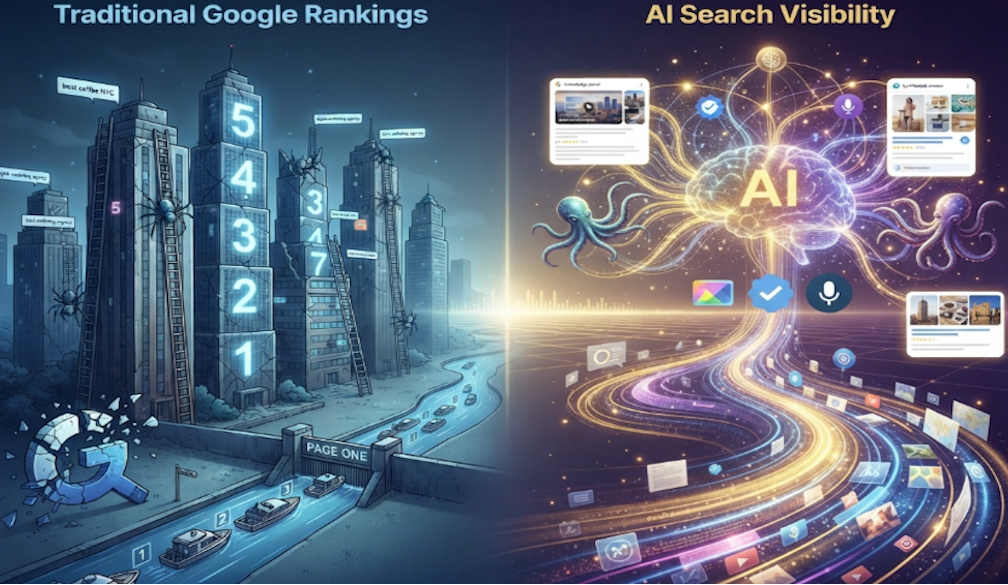
You rank first on Google and AI has never heard of you
Ask a marketing team how their brand performs in search and most will point to their Google rankings. For over a decade that was the right answer. A first-page position meant visibility, traffic, and credibility. In 2026 that answer is incomplete, and for a growing share of buyers it is close to irrelevant.
Here is the finding that should reframe the conversation. Over 73 percent of brands that rank on Google's first page have zero mentions in AI-generated responses (MarTech, 2026). In other words, the search battle companies have spent years and budgets winning does not carry over to the place where a rising share of research now begins: the answer generated by an AI assistant.
Search visibility has changed shape
By 2026, search is no longer defined by position on a results page. It is defined by presence within AI-generated answers and the citations that support them (MarTech, 2026). When someone asks an AI assistant which companies lead a category, or which product suits their needs, the assistant returns a synthesised answer. If a brand is absent from that answer, it is absent from the decision, no matter how well it ranks on a traditional results page.
This is why nearly a third of digital marketing leaders now name generative engine optimisation as their most critical performance priority for 2026, with an average of 12 percent of 2025 digital budgets already directed toward it (Semrush, 2026). The money is moving because the audience has moved.
Being mentioned and being cited are not the same
There is a second layer that most brands have not measured. Being mentioned in an AI answer does not mean a brand's own website is the source the AI relied on. Mentions show how often a company appears in an answer. Citations show which domains and pages the AI platform used as evidence (MarTech, 2026).
The distinction has strategic weight. A brand that is mentioned but not cited is at the mercy of whatever third-party source the AI trusted, which might be a competitor's comparison page, a review site, or an outdated article. A brand that is cited has become the evidence. It controls the framing, and it earns the authority that comes with being the source.
What AI systems actually reward
AI platforms reward authority, and in 2026 authority means being the source of data that other people cite. That points to commissioned surveys, published benchmarks, and original research rather than restated opinion (Semrush, 2026).
This is a meaningful change for how communications teams work. For years, content strategy rewarded coverage of popular topics with well-structured pages. Now the advantage goes to the organisation that produces something genuinely new: a data point, a category benchmark, a survey of its market. When a brand publishes original numbers, it gives AI systems something to quote, and it gives journalists something to cover. The same asset earns citations and media coverage at once.
It is worth being concrete about what citable content looks like, because the phrase invites vague interpretation. A citable asset answers a question a buyer would actually ask, states a specific finding rather than a general claim, and attributes that finding to a clear source and method. A page that says a market is growing quickly is not citable. A page that reports the growth rate, explains how it was measured, and dates the figure gives an AI system something it can stand behind. The discipline is closer to journalism and research than to marketing copy, and organisations that grasp that distinction produce assets that keep earning citations long after they are published.
There is a caution attached to volume. Research indicates that brands producing 12 or more new or optimised pieces of content per month achieve far faster visibility gains in AI platforms than those producing four (Semrush, 2026). The lesson is cadence, not filler. Publishing more thin content will not help. Publishing more content that carries original substance will. The two are easily confused, and the difference decides whether the effort pays off.
How to measure what you cannot see
The reason so many brands are blind to this gap is that their dashboards were built for the old scoreboard. Rank tracking, organic traffic, and click-through rates all describe a results page that a growing share of buyers no longer visit. None of them tell a marketing lead whether an AI assistant names the brand when a customer asks for a recommendation.
Closing that blind spot starts with asking the questions your buyers actually ask. Write down the ten or twenty prompts a prospective customer might put to an AI assistant in your category, then run them and read the answers. Note whether the brand appears at all, whether it is described accurately, and which sources the assistant cites as evidence. This is a manual exercise a team can do in an afternoon, and it usually delivers an uncomfortable surprise. Tools that track AI visibility at scale are maturing quickly, and Semrush's expanded 2026 index alone analysed 126 million AI search prompts to map which brands surface where (Semrush, 2026). The point of measurement is not the number itself. It is knowing whether the answer a buyer receives is one the brand would endorse.
The cost of doing nothing
Waiting carries a compounding cost that a static rankings report hides. AI assistants build their picture of a category from the sources available to them, and once a competitor becomes the cited authority on a topic, that position is difficult to displace. The brand that publishes the definitive benchmark first becomes the reference every later answer leans on. A brand that arrives late is not competing on a level field. It is trying to unseat an incumbent the AI already trusts.
There is a reputational dimension too. When a brand is absent from an answer, the assistant does not leave a blank. It fills the space with whatever it can find, which may be a competitor's comparison page, a dated review, or a forum thread. The brand loses not only visibility but control of its own description. Silence is not neutral in this environment. It hands the narrative to someone else.
Why this forces PR, content, and SEO together
The most useful consequence of this shift is structural. AI visibility works best when it connects to existing communications, content, and search programs rather than sitting alone, and it pushes PR, content, SEO, and product marketing to converge around how AI systems understand a brand (MarTech, 2026).
Those functions have often operated separately. PR chased coverage. SEO chased rankings. Content filled the calendar. Winning a place inside AI answers needs all three pulling in the same direction, because the thing that earns a citation, a piece of original research explained clearly and distributed widely, is exactly the thing that earns media coverage and search authority. An organisation that treats these as one program has a real advantage over one that runs them in silos.
Consider how a single asset can work across all three. A company commissions a survey of its market and publishes the findings. The data gives an AI assistant a specific, quotable statistic, which earns a citation. The same finding gives a journalist a reason to write a story, which earns coverage and authoritative links. Those links raise the domain's standing in traditional search, which feeds back into how AI systems weigh the source. One piece of original work compounds across three channels that used to require three separate efforts. Fragmenting the work across three teams that do not talk breaks that compounding effect before it starts.
For clients, the practical starting point is a simple audit. First, measure current AI visibility, not just Google rankings, because the two often disagree. Second, identify the questions buyers ask an AI assistant in the category, and check whether the brand appears in the answers. Third, decide what original data the organisation can own, and build a publishing cadence around it.
None of this requires abandoning the search work that already delivers. Traditional SEO still drives real traffic, and a strong domain remains an asset that AI systems draw on. The shift is one of addition rather than replacement. The brands that come out ahead treat AI visibility as a new front to win rather than a reason to walk away from the ground they already hold, and they resource it accordingly rather than hoping their existing content happens to surface.
The single takeaway
A first-page Google ranking is now a partial win. The question that decides visibility in 2026 is whether an AI assistant cites your brand as evidence when a buyer asks, and the way to earn that citation is to become the source of something worth quoting. Brands that keep optimising only for the old scoreboard will watch their competitors get quoted while they get overlooked.


 Business Daily Media