To control your spending this holiday season, stick with cash
- Written by: Jay L. Zagorsky, Associate Professor of Markets, Public Policy and Law, Boston University
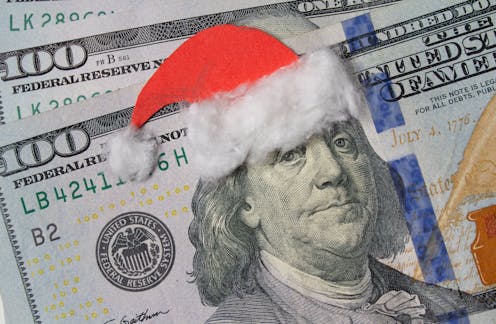
The holiday shopping season is now here, and Americans are ready to splurge. The average U.S. shopper expects to spend more than US$1,000[1] on gifts for Christmas and other winter holidays this year, surveys show.
These days, consumers have no shortage of payment options, each seemingly more enticing than the last. Do you swipe your credit card and pick up “free” miles[2]? Do you use buy-now-pay-later and spread the payments out over time[3]? Do you use a debit card to avoid going into debt?
As a business school[4] professor[5] who writes about the holiday shopping season[6], I’ve been thinking about the best way to pay for holiday gifts without breaking the bank. My advice, found in my forthcoming book[7] The Power of Cash, is counterintuitive. Don’t use any of these things. Instead, use good old-fashioned paper money.
Yes, using cash instead of paying electronically is a simple way to control your holiday spending while even helping others. And I speak from personal experience.
Why cash is less likely to set you back
Before spending any money, it is important to set a holiday budget[8]. The problem is that while everyone thinks setting a budget is a good idea, few people do it, and even fewer stick to it[9].
Budgeting is like dieting[10]: Temptation and time pressure cause the best intentions to fail.
I’ve seen this in my own life. One holiday season I carefully set a budget. However, with only hours left before exchanging presents, I didn’t have anything for three nieces. In my desperation, I wildly overspent on gifts I doubt they ever used.
Using cash can help you avoid making the same mistake I did. It works for some simple reasons:
First, committing to just using paper money provides an automatic method of budgeting. When you’re out of cash, you’re done shopping. Now I don’t recommend putting all of your money into your wallet at once. Instead, take only a portion of your budgeted cash when going shopping, or if you are taking all of it, split the money up and keep some in a separate reserve.
Second, using cash helps you spend less because of the “pain of paying[11].” Spending paper money causes a momentary feeling of regret, research in consumer psychology shows. This in turn helps slow down purchases. People don’t feel the same pain when they use credit cards[12], because the bill comes due in the future.
Third, in the long run, paying cash for things is cheaper because you don’t have to pay interest on purchases. About half of all credit card users carry a balance each month[13]. With the average balance currently over $6,000[14], the interest alone on charging gifts can cost you hundreds of dollars.
And one more point: Many people buy holiday gifts for themselves, and research shows that paying cash makes you initially treasure a purchase more[15] than when paying with electronic means. Cash payers feel stronger ownership because they made a “mental investment” in the item.
Using cash while shopping online
It’s easy to use cash for in-person purchases, but you can’t stick paper money through a computer or phone screen to make online purchases. Yet this holiday shopping season, online purchases are expected to break $240 billion[16].
It is possible to use cash only[17], even if you’re relying on e-commerce. A simple method is to purchase an online retailers’ gift card using cash[18] and add that gift card to your account’s balance. If you want to spend more, you will need to physically get out to a place selling cards like your local supermarket and spend cash.
This triggers the pain of paying and also takes a bit of time, giving you an opportunity to think about whether this is really the right gift and the right amount to spend on it.

One final point: The holiday season isn’t supposed to be just an exercise in consumerism[20]. Instead, one goal is helping others. Paying for gifts with cash actually does this. There are many people without credit cards, debit cards or mobile payment apps who are excluded from shops that refuse to take cash[21].
People without electronic methods are primarily poor[22] and elderly. Millions of Americans are cash payers[23], surveys show, so using cash helps them because it provides a clear signal to businesses that paper money is still wanted and needed.
The holidays are supposed to be fun, but they’re not so enjoyable if you are stressing about money. How do you stick to a budget and ensure you don’t have huge bills to pay after the holidays are over? The answer is simple: Use cash. By itself, cash won’t make the holidays a jolly time, but it removes one big problem.
References
- ^ expects to spend more than US$1,000 (news.gallup.com)
- ^ pick up “free” miles (theconversation.com)
- ^ spread the payments out over time (theconversation.com)
- ^ business school (www.bu.edu)
- ^ professor (www.bu.edu)
- ^ writes about the holiday shopping season (theconversation.com)
- ^ found in my forthcoming book (www.wiley.com)
- ^ important to set a holiday budget (theconversation.com)
- ^ even fewer stick to it (www.cfp.net)
- ^ is like dieting (healthcarenews.com)
- ^ pain of paying (thedecisionlab.com)
- ^ when they use credit cards (insidebe.com)
- ^ half of all credit card users carry a balance each month (www.bankrate.com)
- ^ average balance currently over $6,000 (money.usnews.com)
- ^ research shows that paying cash makes you initially treasure a purchase more (www.jstor.org)
- ^ online purchases are expected to break $240 billion (www.usatoday.com)
- ^ use cash only (www.usatoday.com)
- ^ online retailers’ gift card using cash (www.goodhousekeeping.com)
- ^ Burak Sür/E+/Getty Images (www.gettyimages.com)
- ^ exercise in consumerism (www.marketplace.org)
- ^ excluded from shops that refuse to take cash (theconversation.com)
- ^ People without electronic methods are primarily poor (www.census.gov)
- ^ Millions of Americans are cash payers (business.yougov.com)
Read more https://theconversation.com/to-control-your-spending-this-holiday-season-stick-with-cash-244711