

Older 'sandwich generation' Californians spent more time with parents and less with grandkids after paid family leave law took effect
- Written by: Joelle Abramowitz, Assistant Research Scientist at the Survey Research Center, University of Michigan
The Research Brief[1] is a short take about interesting academic work.
The big idea
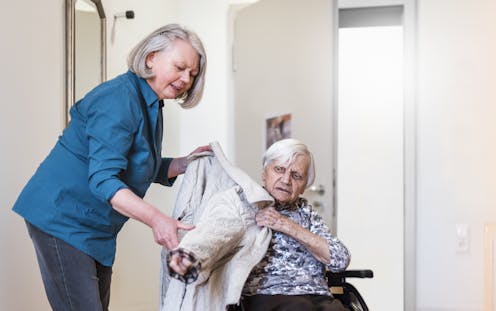
A California law that mandates paid family leave has led to adults in their 50s, 60s and 70s spending more time taking care of their parents and less time being their grandkids’ caregivers.
The law requires all employers to allow eligible workers to take up to six weeks of paid leave[2] to care for newborns, newly adopted children or seriously ill family members.
From 2006, two years after the law went into effect, to 2016, this policy led to older adults’ spending 19 fewer hours[3] per year caring for their grandchildren, a 17% decrease. They spent 20 additional hours on average helping their own parents, a 50% increase.
The effect was most striking for people with newborn grandchildren and parents in need of help, but the law also benefited Californians with older grandchildren and those who don’t have parents requiring their assistance.
These findings[4] are from research I conducted with Marcus Dillender[5], a fellow economist. They suggest the law had effects through two channels. It enabled older adults to take paid leave to care for relatives with medical needs and it reduced the need for older adults to care for their grandchildren by granting paid parental leave to these children’s parents.
To assess how older adults spend their time, we analyzed data for people between the ages of 50 and 79 from the Health and Retirement Study, a longitudinal study of approximately 20,000 Americans[6].
The survey asks respondents in that age group how much time they spend taking care of their grandchildren and helping their aging parents with basic personal activities like dressing, eating and bathing. We compared outcomes for people who lived in California with what happened to Americans in other states before and the law’s enactment.
We also looked into what happened for people who had different combinations of caregiving obligations – grandchildren less than 2 years old or older grandkids, or parents who need help or no parents requiring assistance.
Why it matters
The U.S. is the only wealthy country that doesn’t require employers to provide paid family leave[7]. California was the first state to implement its own policies; 10 others and the District of Columbia[8] have followed suit so far.
These policies can significantly affect older adults, who spend substantial time caring for their relatives.
Caregiving has become a more urgent policy issue because of the growing number of Americans who feel that they belong to a “sandwich generation[9]” of people who have to take care of their children or grandchildren and their parents at the same time.
What other research is being done
Other research has found that California’s paid family leave policy doubled the overall length of maternity leave by new mothers, increasing it from an average of three weeks to six weeks[10]. It also upped the likelihood that fathers take parental leave[11] following the birth or adoption of a child by 46% – although fathers take less leave on average than mothers[12].
According to some of the many other studies conducted so far, California’s paid family leave law helped workers with caregiving responsibilities stay employed by allowing them to take time off with reduced financial risk and increased job continuity, including for those ages 45 to 64 with a disabled spouse[13] and middle-aged female caregivers[14]. The law has, in addition, reduced the share of elderly people using nursing homes by facilitating more informal care[15].
References
- ^ Research Brief (theconversation.com)
- ^ take up to six weeks of paid leave (edd.ca.gov)
- ^ this policy led to older adults’ spending 19 fewer hours (ca.db101.org)
- ^ These findings (doi.org)
- ^ Marcus Dillender (scholar.google.com)
- ^ longitudinal study of approximately 20,000 Americans (hrs.isr.umich.edu)
- ^ doesn’t require employers to provide paid family leave (www.oecd.org)
- ^ 10 others and the District of Columbia (www.ncsl.org)
- ^ sandwich generation (www.michiganmedicine.org)
- ^ increasing it from an average of three weeks to six weeks (doi.org)
- ^ fathers take parental leave (doi.org)
- ^ fathers take less leave on average than mothers (doi.org)
- ^ including for those ages 45 to 64 with a disabled spouse (doi.org)
- ^ middle-aged female caregivers (doi.org)
- ^ facilitating more informal care (doi.org)






